
Group of the month at iNANO
The Nanobiointerfaces Group is Group of the Month at iNANO
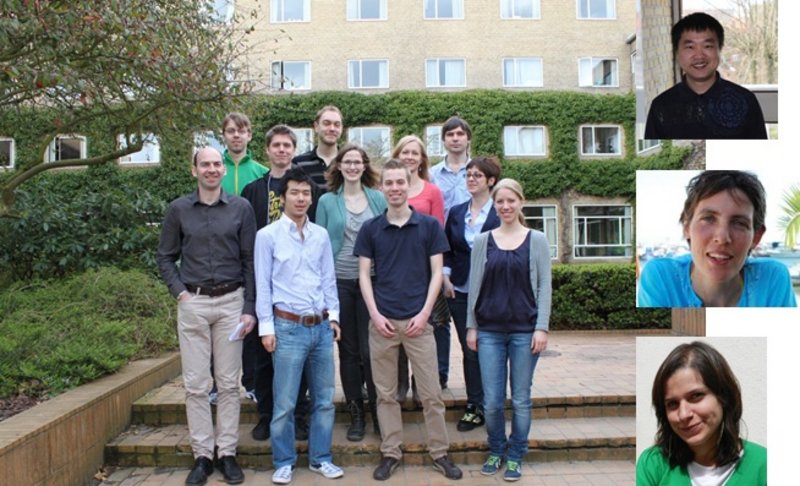
The Nanobiointerfaces Group has been named Group of the Month at iNANO. Apart from having a wide range of scientific interests in the nano and bio worlds, the group is also a multicultural one, currently hosting 7 different nationalities among its 4 senior researchers and 9 PhD students.
On this happy occasion, Andrea Søe Andersen got an interview with the Nanobiointerfaces group leader, Associated Professor Duncan Sutherland. With Andreas’ permission, parts of this interview can be found below. The full interview can be accessed here.
Duncan Sutherland told us a little bit about the group’s scientific interests: “There are two different directions, one of which is nanostructures and biological molecules and the other is looking at plasmonics”.
The work in this group combines basic research and engineering: “The main research we do is driven by developments in engineering and using that as a way to study some physical science and biological science questions. It’s not really applied research, but it has got a strong link to engineering. Often we might develop engineering methods, which might be interesting by themselves, but the only real reason to apply them is to get answers to some biological questions”. The engineering comes in play when making large areas of pattern “to allow well defined structures over a big enough scale to do lab scale experiments”. As Duncan Sutherland added, this is very useful for several lines of research: “In heat transfer we are able to make a few square centimetres with nanostructures, which is not easy. For the cell work, it is the patterns of proteins and for the plasmonics research, it’s the shape of the particles, how the dielectric is surrounding the particles and the particle distances”
The biological research focuses on two main aspects, the first dealing with proteins and nanostructures through sensors and toxicology projects and the other one is, as Duncan Sutherland says, “to use the patterning as a tool to study cell adhesion and transduction”. The group members who are interested in the physical science work with nanoscale patterning for research in heat transfer and plasmonics.
The most recent lines of research the group is working in are “cell-cell contacts, looking at how nanoscale matters in the clustering in cell-cell contacts and using nanostructures for enhancing heat transfer”.
Apart from the actual research work going on in the Nanobiointerfaces Group, Associated Professor Duncan Sutherland answered some of Andreas’ questions regarding the publications he is most proud of. “One that I’m proud of is the Nano Letters article by Jenny Malmström, published in 2011 showing the protein you had made into a small pattern changed the mechanotransduction. I’m proud of that because my background is in physics and this gives information on a biological system and it was picked up by the faculty of 1000, which mostly looks at biological articles and it’s a peer review type system so that the people in this faculty 1000 should pick up articles which are relevant and they picked it up and thought it was relevant for biology, so I’m quite proud of that” [i]. He also mentioned a 2007 Nano Letters paper by former PhD student Elanor Larson [ii], which “was the experimental demonstration that changed the way people thought about plasmonic particles and how the dielectric surroundings were important”. Duncan Sutherland added that the group’s latest publication was another Nano Letters paper, by Stine Kristensen: Nanoscale E-Cadherin Ligand Patterns Show Threshold Size for Cellular Adhesion and Adherence Junction Formation [iii].
Finally, when asked to describe his group in one sentence, Associated Professor Duncan Sutherland said: “International and interdisciplinary and prepared to listen to and try research even if it sounds a bit scary”.
...........................................................................................................................................
[i] Malmstrom, Jenny; Lovmand, Jette; Kristensen, Stine; Sundh, Maria; Duch, Mogens; Sutherland, Duncan S.: Focal Complex Maturation and Bridging on 200 nm Vitronectin but Not Fibronectin Patches Reveal Different Mechanisms of Focal Adhesion Formation. Nano Letters, 2011, 11 (6), pp 2264–2271.
[ii] Larsson, Elin M.; Alegret, Joan; Kall, Mikael; Sutherland, Duncan S.: Sensing characteristics of NIR localized surface plasmon resonances in gold nanorings for application as ultrasensitive biosensors. Nano Letters, 2007, 7 (5), pp 1256-1263.
[iii] Kristensen, Stine; Pedersen, Gitte A; Nejsum, Lene N and Sutherland, Duncan S. Nanoscale E-Cadherin Ligand Patterns Show Threshold Size for Cellular Adhesion and Adherence Junction Formation. Nano Letters, 2012, 12 (4), pp 2129–2133.