
The Fun in Science and the Science of Fun at the iNANO PhD Autumn School
The 2012 iNANO PhD Autumn School is over and people have had time to let the whole experience sink in. Two weeks after the science and fun-filled 4 days-long working weekend, we fondly look back on the event, draw some conclusions, get the opinion of some of the participants and learn a bit about what we should expect for next year.
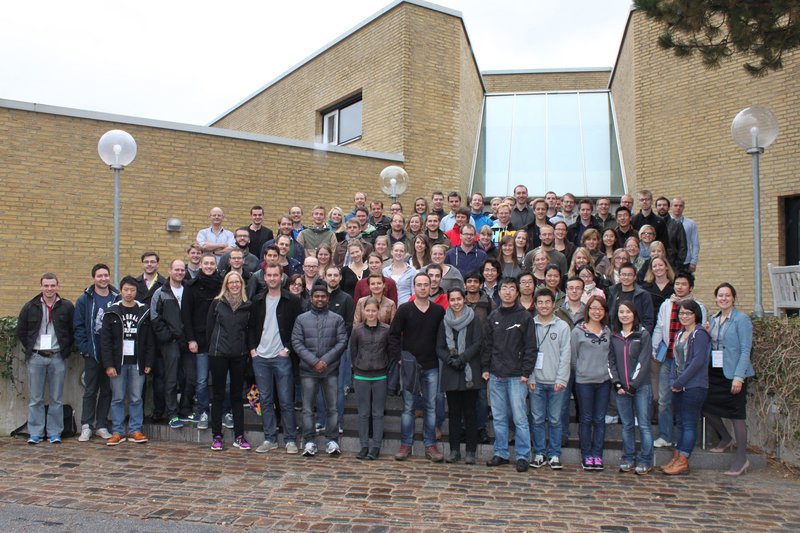
In Professor Niels Christian Nielsen’s words, “I think we had a great autumn school this year, mainly focusing on scientific presentations in relation to three important themes at iNANO: nano/energy materials, nanomedicine and nanofood. Many presentations were given in the form of lectures from external and internal researchers, as well as lectures and posters from the PhD students. In addition to disseminating good science, a focus point was also presentation techniques. Here we saw a broad spectrum of different presentation forms and I appreciated the excellent student presentations and the discussions around these on the theme and way of presentation”.
The assessment of a high level of the presentations given by the part B students seems to be unanimous among the scientists who chaired the student sessions. Associate Professor Victoria Birkedal added she “very much appreciated that there was a good participation in the sessions and that there were questions from students after almost each talk”. Dr. Peter Thostrup suggested the student speakers could improve on especially one point: taking into account who the target audience is and preparing the presentations accordingly. He added that he “witnessed most of the winning talks and all were characterized by a transparent train of thought and a clear take-home message”.
Even though all the presentations were good, some of them stood out. The student presentation awards were given to: Mie Andersen, for her talk on decoupling the graphene-substrate interaction by intercalation, Nikolai Lorenzen, for his presentation on how the flavonoid epigallocatechin gallate inhibits alpha-synuclein olligomer’s ability to permeabilize membranes, Ole Zoffmann Andersen, who talked about how to enhance bone growth by local delivery of strontium from surface functionalized titanium implants, Camilla Lund Nikolajsen, for her presentation of the proteome level identification of coagulation factor XIIIa substrates in plasma in relation to the regulatory role of protein cross-linking in coagulation and wound healing, Sarah Helming, who talked about 3D DNA origami and the latest steps towards its applications in medicine and molecular engineering and Yuya Hayashi, for his talk on the evolutionary-conserved gene/cellular responses to silver nanoparticles studied using human cell lines and earthworm primary cells.
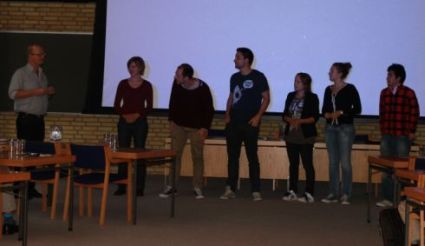
Both Part A and Part B PhD students participated in the two poster sessions. They also voted for the winners of these sessions, and chose the following three as the best: Jesper Vinther, Qiang Li and Mathias Vinther.
Of course, since all work and no fun makes for unhappy PhD students, there were also events targeting relaxation, entertainment and networking. It started shyly with the Bulgaria vs. Denmark football game on Friday evening, where students had a few beers and discussed the science of the round ball, tired after a long day. The excitement came on Saturday night, when team work, intelligence, humour and competitiveness joined hands in a fun-filled gaming night that Duncan Sutherland’s team won after a thrilling final.
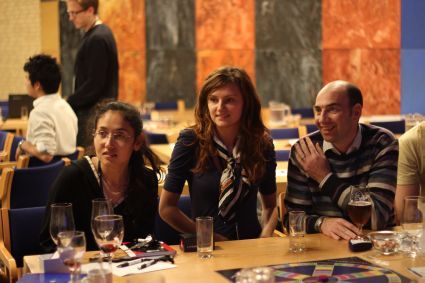
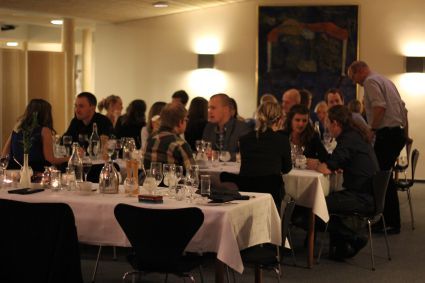
Since networking was an important part of the Autumn School, we had many opportunities for that, including a lovely banquet that we enjoyed on Sunday night.
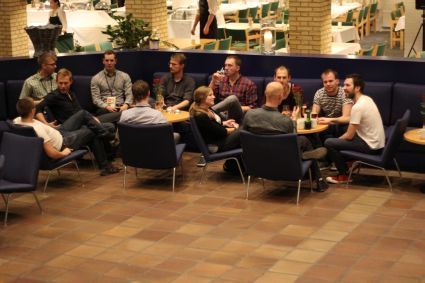
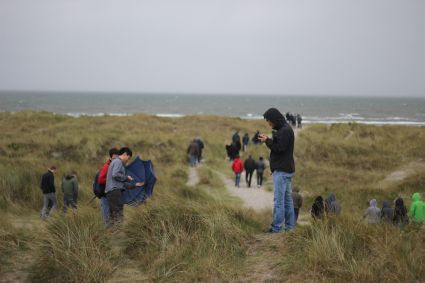
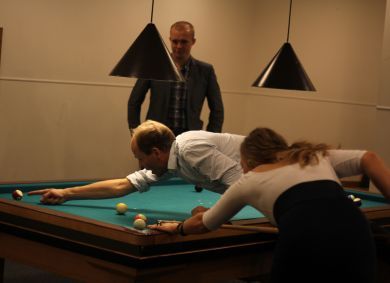
At the end of the day, after a walk-and-talk session that we endured in the pouring rain, everybody relaxed, some enjoyed a game of pool and there was even some dancing.
As it was mentioned several times during the Autumn School, a big thank you for the success of this even should go to Rebeca Thostrup and Kaj Mikael Jensen who organised these 4 days of science and networking. The Autumn School is over for most of us, but, after everything was said and done, Rebeca and Kaj got feedback from the participants and have already started to think about next year’s event. Kaj mentioned that, as many students requested, “next year will focus on non-scientific skills, such as leadership, writing a paper, writing a grant application and communication skills.”
While we are waiting for the Autumn School of 2013, the concluding remarks for this year’s event are, in Professor Niels Christian Nielsen’s words: “The PhD students and the iNANOschool are the most important element of iNANO – our good students, as demonstrated so nicely in this meeting, are the key to excellent research and collaboration. Seeing so many good presentations, living science, and strong social interactions in the Autumn School reinforces me this impression and our interest in making iNANOschool a strong club and a world class education nest for the next generation of nanoscience scientists in broad areas of society.”
P.S. Those of you who want the photos taken at the Autumn School please contact Teodora.